Friday, 13 May 2016

Portfolio

I have chosen to create a physical portfolio and a website to represent my work. As I am designing for an interior context I've created an A1 portfolio of artworks, visualisations and to scale designs as well as designs showing their repeat. Putting the physical portfolio together has been a great experience because I have been able to review my work and see the journey of my project.

I have also created a website with an online portfolio, I think a website is key in the digital society that we live in today. Companies can easily access your work and you can regularly update your website to keep people interested.

The link to my website ... www.efreeman-design.com


Friday, 29 April 2016

Context

I've aimed to produce a diverse collection of feature designs for interior that appeal to those buyers who are looking for a print that could stand-alone in a room. I have also created complimentary designs to co-ordinate with the feature designs because I've learnt the importance of creating a varied collection.

By conducting market research at different levels, I have found that there is a demand for this style of painterly florals. BHS, Zara, John Lewis and Matalan are a few of the high street stores that feature this trend.


I have developed my designs for a range of home wares because I wanted to create collections that could be easily translated into different rooms and products.


I wanted to push myself to try and contextualise my designs in new ways, once I started to visualise my designs on tableware I researched into how I could create physical samples. 

Friday, 15 April 2016

Development

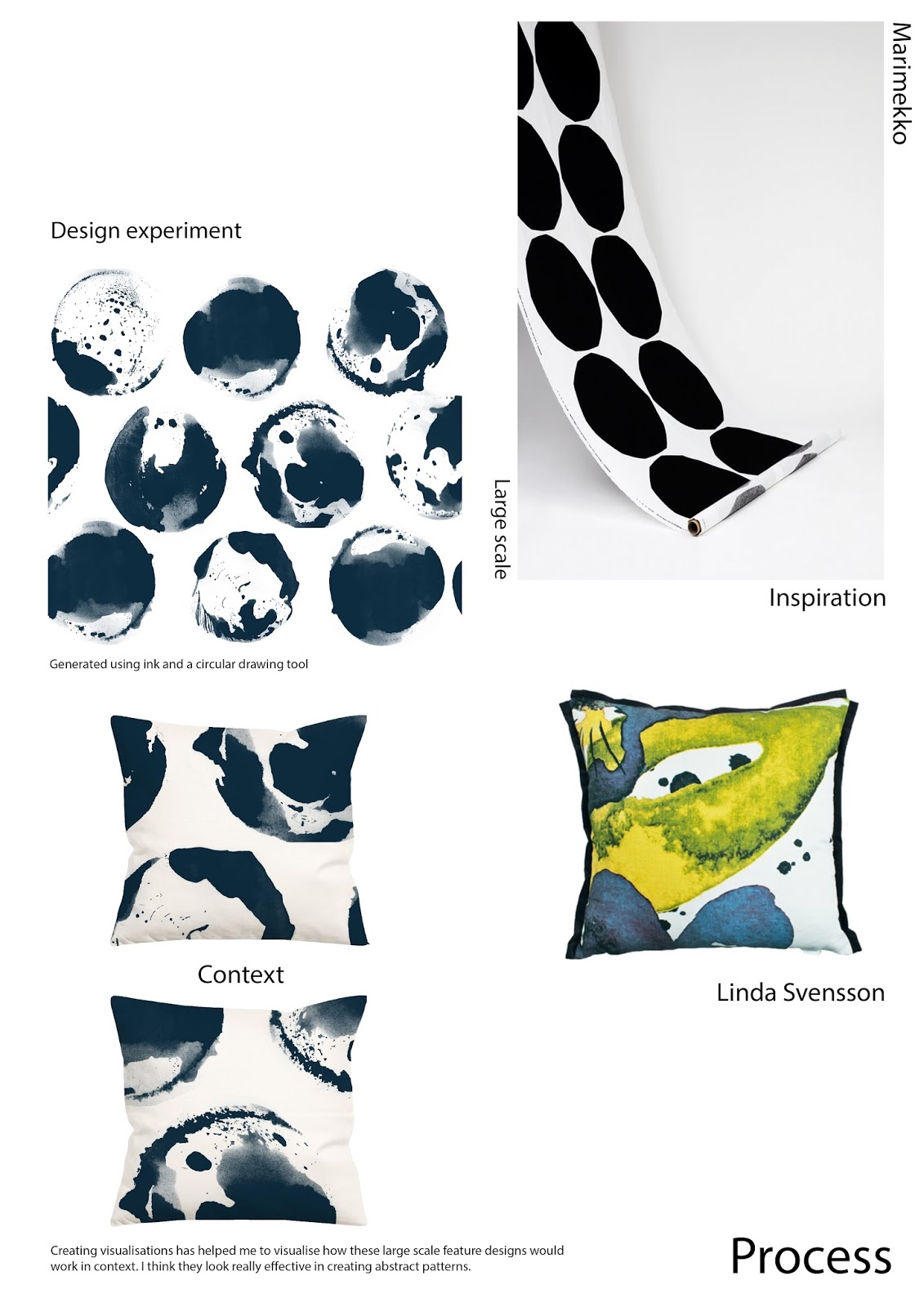
A huge focus of my project has been on scale, I wanted to produce large scale prints that when put into context look abstract and oversized. For example I think that the two cushions (seen below) are really effective in creating an abstract aesthetic. I like how one print design can create a number of different placement ideas.


Another stage of development was selecting the right colour palettes. Initially I hadn't planned to use more than one colour palette but after realising that it would broaden my portfolio and push my practice I decided to create 3 different collections each with a colour mood. 

It took some trial and error to find the right colour moods as I wanted colours that were sophisticated and told a story from one another.


Above shows the colour development of one of my designs, Initially I  liked the motifs but felt that the composition and colour wasn't working, I then developed the design and the colour but still didn't like the way the colour was spread so I decided to try this design in the two tone colour palette and invert the colours. I believe that this design is now fresh and lively.

Friday, 11 March 2016

Research

I have built on the research I acquired in the Practice unit, both contextual and visual research. 

Whilst conducting market research I've noticed that a lot of high street homeware stores have adapted the painterly floral trend in Spring Summer. This is both a positive and a negative, a positive because there is clearly a demand for this kind of product, a negative because it means that I will need to make sure my work is original in comparison.


Although I am using the same concept of painterly florals I wanted my visual research to be different to that I created in the Practice. Instead of creating ariel view paintings I have been creating still life compositions that could be sold as artworks in their own right. I tried to create paintings in the colours of my palette but I find it so much easier to paint in black and white as I can completely concentrate on the painting rather than mixing colours. It is however something I want to be able to do in the future.

Example of Practice visual research
Example of Unit X visual research

Friday, 26 February 2016

Project Introduction

During this unit I want to expand my practice to produce a number of digitally printed collections that explore scale, composition and colour.

I particularly want to explore scale as this was something I started  experimenting with in the Practice unit. I'm going to look at using the full width of a furnishing fabric (140cm), whether it’s scaling up my motifs or creating large abstract feature designs. 

Creating a number of collections with different colour moods will be a challenge for me as I am used to creating one collection with one colour palette, but pushing myself to do different colour moods will broaden my design portfolio.

Sunday, 7 February 2016

Practice Unit Evaluation

I feel I have continued to challenge myself throughout this unit. To begin with I was quite hesitant to move away from the linear drawing style I had adopted and challenge myself with the unfamiliarity's of abstract mark making but I'm so glad I did as it has really pushed and developed my practice. I'm proud of the work I have produced and feel that it is reflected in how I have applied myself throughout this unit. 

Initially I was concerned about the quick turn around of each project, having 4 weeks for each, doesn't seem long at all, but I've been so surprised by the amount of work I have produced and how it has developed from my initial ideas. I'm pleased that I have managed my time quite well, generating outcomes for three projects. I do however wish I had made some more time for the development of my self initiated project since Christmas but I do feel I have started something quite interesting and have shown the potential of an idea I plan to develop into unit x.


Having the Bradford textiles Society Competiton brief and the Adamley live brief to complete gave me a chance to engineer prints for different audiences as well as my own self initiated brief. Being able to Complete different briefs is a huge part of being a designer in the industry, especially a freelance designer, so having such short turn arounds has been an eye opener for what the industry might be like.

I feel that I have improved my understanding of the print for interiors industry, getting to grips with printing to scale samples and also complimentary designs. 

If I was to compare where I am now to where I was this time last year or even at the end of last year, I would say my practice has developed hugely. I take the time to consider what I am doing a lot more, especially now as I am producing work that will be in my graduate portfolio. I feel that I have developed a characteristic style that is unique and exciting, I'm looking forward to unit x as it will be a further opportunity to develop my skills and understanding.
 

Thursday, 4 February 2016

Week Beginning 1st February

As this is the final week of the unit, my time has been focused on preparing for assessment. It's been really interesting to see how much work I've  generated over the unit and how my ideas have developed. I'm glad I've been quite organised throughout, it's meant I've not had to catch up on too much work at this late stage. 

In terms of my self initiated project I have begun to develop ideas for the scaling up aspect I've discussed in my learning agreement.  This has been something I've really wanted to explore but having only a week or two left after completing the live brief and wanting to start preparing for assessment, this development has taken a back seat. Saying that I have generated 2 feature designs that are 140cm width and experimented with visualising them on cushions in different placements. In the mood board below you can see how I have developed the idea, the cushions are a really exciting starting point. This is an interesting development that I plan to continue with into unit x.


Process Moodboard

I have also been working on complimentary designs for the collection I produced in the first 4 weeks as this was something I originally planned to do. I've generated a number of designs, in different colour ways, that I believe compliment but also contrast with my 4 upholstery designs. Until this unit I'd never really thought about complimentary design and now when I look at a designers collection, i'll look out for the main designs and those that are coordinating with them.